
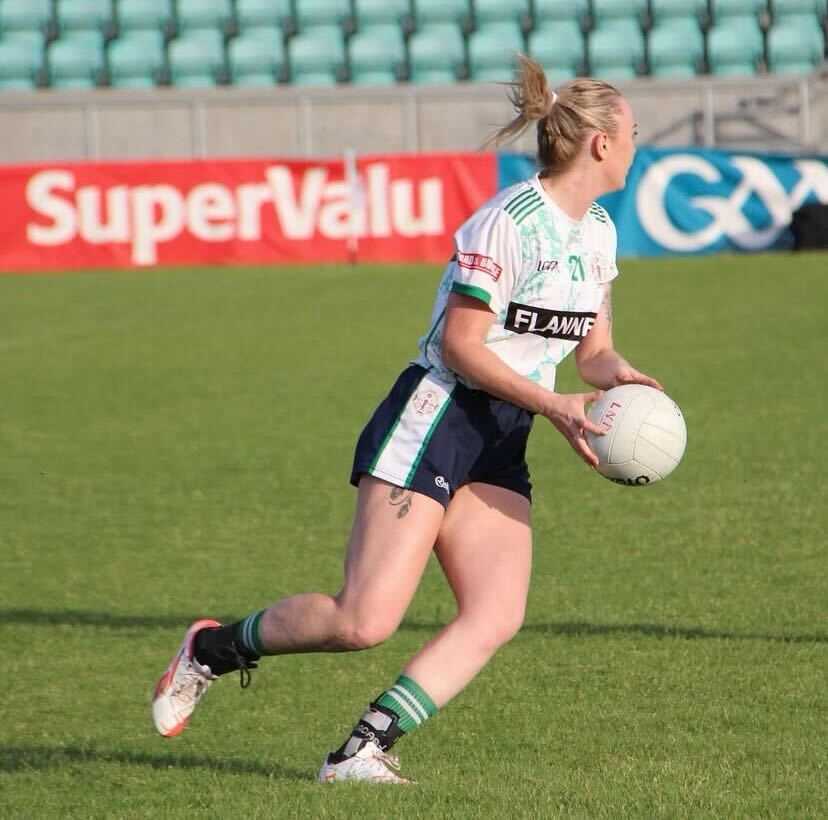
Whether you’re starting or on the bench, there’s still a job to do.
Why selection hurts more than it should
Selection is something you can’t fully control, yet it can feel entirely personal. You can train every session, play well all season and still find yourself on the bench for the biggest game of the year.
When football is a big part of your life, being picked to start can become tied to how you see yourself as a player. Psychologists Crocker and Wolfe explored how people connect their self-worth to particular areas of their lives. If football is one of yours, a team sheet can feel less like a tactical decision and more like a judgement on your ability.
Of course, not every player sees it that way. But I did.
Last year I played the whole way through the championship to the London County Final. I felt I was playing well. I was fit, my passing and kicking were on target, and I’d done a lot of work behind the scenes on my mental health. I really felt this was my year. My year to feel what other girls get to feel out on that pitch, where the win is yours as much as anyone else’s when the whistle goes.
That isn’t what happened.
I was benched for the County Final, the All-Britain Final and the All-Ireland Quarter Final, and I was devastated. I couldn’t hide my emotions or pretend I was ok. I was heartbroken, and whether I came on or not, my head was gone.
To this day, neither of those wins feels like mine. By the time the quarter final came around, I was emotionally exhausted. I was struggling to celebrate the team’s success while feeling so disappointed about my own involvement, and I didn’t know how to separate the two.
My teammates will tell you it’s a team effort, and they’re right. But the contribution is different for different players. I wanted to play, to feel like I’d made a difference. Instead, when I did get minutes, I felt like I was being brought on for the sake of it. That might not have been true. It’s how it felt at the time.
Looking back, I know I didn’t handle it well. I was so caught up in not starting that I stopped recognising the part I’d already played in getting us there.
And now, a year later, I’m preparing for another championship final on Saturday.
I’d love to say everything I’ve learned about sports psychology means I’ve completely figured out how to deal with selection. I haven’t. I still want to start the biggest games, and I still find the uncertainty and disappointment difficult.
But I remember how I felt after last year’s finals, and I don’t want to repeat that experience. Whatever my role on Saturday, I want to be ready to contribute.
It’s still a team sport
There’s a difference between playing sixty minutes of a final and watching sixty minutes of it. Being part of the same squad doesn’t mean everyone experiences the occasion in the same way.
But the starting fifteen don’t prepare for a championship on their own. They need a squad training alongside them, competing for places and ready to contribute.
I’ve trained alongside the starting players all season. I still want to start finals, and I still believe I have something to offer on the pitch.
But I can’t make my contribution conditional on getting the role I want.
So, whether you’re waiting for the team to be named, starting or on the bench, here are a few things worth thinking about during championship week.
The days before the team goes up
For some players, the uncertainty before the team is named is harder than the decision itself. It’s easy to start reading into things at training. Who wore which bib. Whether the manager spoke to you. Who played in your position during a drill.
Other players might not think much about it at all.
If you do find yourself overanalysing selection, there are ways to stop it taking over your week.
Do:
- Focus on what you can control. Your effort, work rate and preparation are yours regardless of selection.
- Keep your routine. Same sleep, same food, same training.
- Train properly with the players around you. Everyone is preparing for the same match.
Don’t:
- Treat training bibs as confirmation of the team. They might give you an indication, but they aren’t the final decision.
- Add extra sessions just to prove a point. Turning up tired won’t help you on Saturday.
- Spend the week comparing yourself to the player you think you’re competing with. Focus on your own performance instead.
If you’re starting
Being named in the starting fifteen can bring its own pressures. For some players, the excitement of being selected comes with a feeling that they now have to justify the manager’s decision. Others will take confidence from being picked and get on with preparing for the match.
If you do find yourself worrying about proving you deserve your place, it can take your attention away from the things that got you selected in the first place.
Do:
- Trust the work that got you selected. You don’t need to change how you play because it’s the final.
- Focus on your role and what the team needs from you.
- Prepare as you normally would. There’s no need to reinvent your routine for one match.
Don’t:
- Put unnecessary pressure on yourself to justify your selection.
- Spend the week constantly replaying what might happen. Deliberate imagery can be useful, but worrying about every possible mistake isn’t the same thing.
- Feel guilty about starting because a teammate is disappointed. You didn’t pick the team, and your job is to play your best football.
If you’re on the bench
Being named on the bench affects players differently. Some will be disappointed, others might have expected it, and some will be happy to be part of the squad.
Whatever your reaction, it’s worth preparing for the possibility that you’ll be called on.
You might get twenty minutes. You might get five. You might not get on at all. You won’t necessarily know beforehand, so being ready matters.
Do:
- Warm up properly and stay warm. You could be needed at any point.
- Know what you’re being brought on to do. If you’re unsure, ask before the match rather than when you’re about to go on.
- Watch the player in your position and the player marking her. You may spot something useful from the sideline.
- Have something simple to focus on if you come on. Your first pass, your first tackle, your first run.
Don’t:
- Spend the match dwelling on whether the manager made the right decision. It can distract you from what’s happening on the pitch.
- Take your frustration out on the player starting ahead of you. She didn’t pick the team.
- Try to prove a point with every touch if you get on. Play your normal game.
- Switch off because you don’t expect to get minutes.
You don’t have to agree with the manager’s decision to be ready if you’re needed.
I’ll have plenty of time to think about my own football after the final. For now, I’ve a job to do.
Related articles
- Article Understanding Championship Pressure and Fear of Failure
- Toolkit Self-Talk and Confidence Toolkit
- Affirmations Championship Affirmations
References
- Crocker, J., & Wolfe, C. T. (2001). Contingencies of self-worth. Psychological Review, 108(3), 593-623.
- Brewer, B. W., Van Raalte, J. L., & Linder, D. E. (1993). Athletic identity: Hercules’ muscles or Achilles heel? APA PsycNet record: https://psycnet.apa.org/record/1994-03969-001 International Journal of Sport Psychology, 24(2), 237-254.
- Mageau, G. A., & Vallerand, R. J. (2003). The coach-athlete relationship: A motivational model. Journal of Sports Sciences, 21(11), 883-904.
- Lazarus, R. S., & Folkman, S. (1984). Stress, Appraisal, and Coping. Springer Publishing Company. Buy on Amazon
- Jones, M., Meijen, C., McCarthy, P. J., & Sheffield, D. (2009). A theory of challenge and threat states in athletes. International Review of Sport and Exercise Psychology, 2(2), 161-180.
- Nicholls, A. R., & Polman, R. C. J. (2007). Coping in sport: A systematic review. Journal of Sports Sciences, 25(1), 11-31.
- Ames, C. (1992). Achievement goals, motivational climate, and motivational processes. In G. C. Roberts (Ed.), Motivation in Sport and Exercise (pp. 161-176). Human Kinetics. Buy on Amazon
Looking for practical tools to use this in real matches?
Go to the Gael Performance Toolkit for practical tools related to this article.
Open Gael Performance ToolkitHave feedback on this content?
Share feedback